On this page
Reporting to parents and whānau
Guide to your child's reporting and progress
Overview#
The updated English and Mathematics and Statistics learning areas for Years 0 to 10 is changing the way schools report on your child’s progress.
New Zealand Curriculum guide (Years 0 to 8)
New Zealand Curriculum guide (Years 9 to 10)
New reporting has been designed to align to the new curriculum, and to support clear and consistent reporting so you can understand how your child is progressing each year, regardless of which school they attend.
This change means there will be 1 of 5 progress descriptors used to describe your child’s progress in Reading, Writing, and Maths. At the end of the year, children who are proficient or above show they are ready for the next year of learning.
New reporting includes:
- a narrative about why the overall progress descriptor was chosen
- information about how you can support your child’s next learning steps at home
- a visual representation of your child’s progress over time.
In recognition of the important link between attendance and learning, attendance data will also be included.
Progress descriptors#
Progress descriptors are clear, nuanced, and positive, and help identify where a child is achieving, and what is needed to support further progress.
At the end of the year, children who are proficient or above show they are ready for the next year of learning.
We explain below each of the progress descriptors you may see on your child’s report.
Emerging#
Students require support to meet curriculum expectations for their year level and/or goals as described in their personalised learning plan.
Your child:
- is beginning to understand some learning ideas for their year level with a lot of support
- can sometimes use knowledge they’ve learned, but usually needs help to do so
- is making some progress in ways that are meaningful and aligned to their strengths and needs, with significant support.
Developing#
Students are making some progress towards curriculum expectations for their year level.
Your child:
- is starting to understand key ideas, often with some support
- can remember facts and use what they’ve learned in familiar situations, with a bit of help
- with the right support, your child is making progress towards the expectation for their year level.
Consolidating#
Students are meeting many curriculum expectations for their year level and are steadily strengthening their understanding across learning areas.
Your child:
- is learning to use helpful techniques on their own to support their learning
- is getting better at remembering and using what they have learned
- is starting to use what they know in new and different situations
- can share their ideas and is beginning to talk about what they would do better.
Proficient#
Students are meeting curriculum expectations for their year level.
Your child:
- can use helpful learning techniques on their own and knows how to use them well
- can use what they’ve learned in different situations without help
- can often use what they know in new situations
- can share their thoughts clearly and explain their reasoning
- often shares their ideas to build knowledge.
Exceeding#
Students are exceeding curriculum expectations for their year level.
Your child:
- shows advanced thinking by understanding tricky ideas, solving problems, making connections, and explaining their thinking clearly
- can link what they’ve learned in 1 area or situation to another
- can build on their ideas and show deeper understanding
- can use what they’ve learned in thoughtful and creative ways to understand more challenging ideas
- tests and challenges ideas to create deeper knowledge.
Is my child on track#
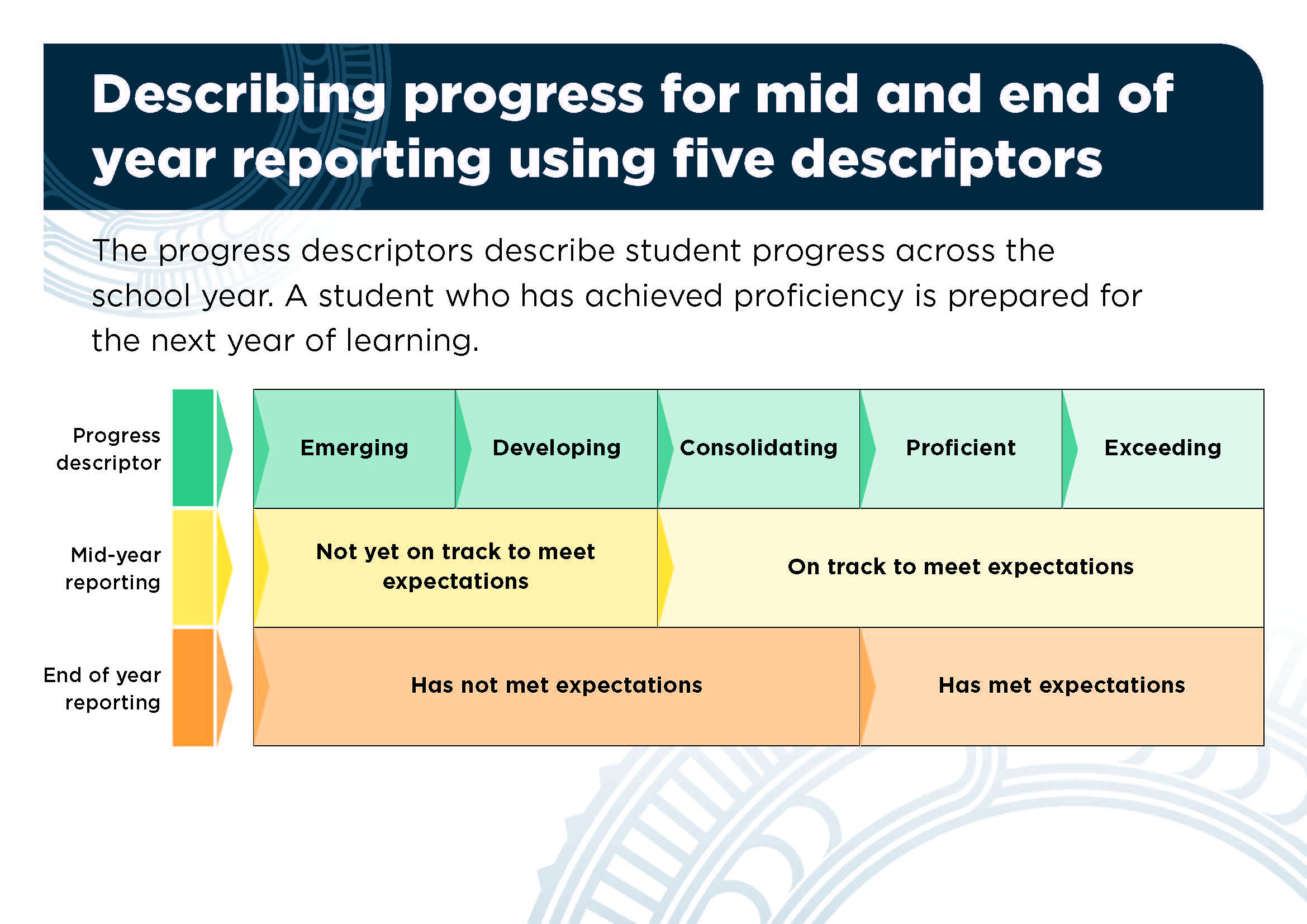
The diagram below shows how progress descriptors show your child’s progress in their mid-year and end-of-year reports and their level of readiness to engage in the next year of learning.
If at mid-year a teacher considers your child to be:
- emerging or developing, they are still working towards meeting expectations, and their progress is not yet on track to meet end-of-year expectations for their year level. In this situation your child’s school may provide additional learning support
- consolidating, proficient or exceeding, their progress is on track. In this situation your child’s school may provide extended learning opportunities and enrichment activities.
If at the end of a year, a teacher considers your child be:
- proficient or exceeding, their progress and achievement has met curriculum expectations
- emerging, developing, or consolidating, they have made progress towards expectations and are still working towards achieving the expected outcomes for their year level. They have not met curriculum expectations for their year level. In this situation, your child's school may offer additional support to your child, and their current teacher should discuss a learning plan for next year with their new teacher.
For students with diverse learning needs, or who have individualised progress goals and assessments outlined in their IEP, the descriptors will still be used.
How teachers will select progress descriptors#
Selecting the right descriptor involves professional judgement, evidence from multiple sources, and a well-rounded understanding of your child’s knowledge and capabilities.
No single piece of evidence can provide a teacher with the full picture of your child’s learning progress. A teacher will bring together multiple sources of information, to gain a clearer, more reliable understanding of your child’s progress and achievement.
This includes information from throughout the year from observations, conversations with students, tasks, and data from assessment tools (Phonics Check, e-asTTle, PATs, SMART).
It is important as parents and whānau that you can access these results if you want them. Schools may include this information in your child’s report, attach the results to the report, or provide you with access in another way such as during parent-teacher interviews or via a school information portal.
Your child’s report#
At least twice a year, schools are required to provide a written report to you, in plain language, on your child’s progress and achievement across the curriculum. From 1 January 2027, schools will have to include the following elements. This will be in addition to other information the school currently includes in its reports.
The elements are:
- results from twice-yearly assessments
- progress against strands in the English and Mathematics and Statistics learning areas
- progress and achievement in reading, writing
- progress descriptors
- information about how the schools is supporting the students if they are well below curriculum expectations
- an attendance record (except for distance schools)
- student's next learning steps.
Example#
Below is an example of how these elements may appear in your child’s report. Existing reports can still be used by schools as long as these elements are included.

Progress over time visual
A graph of progress over time allows you to understand the progress and achievement of your child, not only within their current year of learning but also across multiple years throughout their schooling.
The example above shows what this could look like for a mid-year report in Year 4. This example image has been designed to show progress against the curriculum expectations for your child’s current year level, rather than comparing to years below or above. This ensures a focus on whether your child is meeting, exceeding, or still progressing toward the expectations for their current year, rather than comparisons across and between years.
Children with complex learning needs#
From 2027, the components described above will appear in reports for all children in New Zealand, including those with complex learning needs. The progress descriptors chosen by teachers will show how your child is moving toward the curriculum goals, and the teacher’s narrative will explain this progress in more detail recognising your child’s individual needs and learning plan.
If your child has complex learning needs and requires tailored support for their learning, this does not mean that they are not proficient in the curriculum. They should not be automatically assessed as ‘Emerging’, or ‘Developing’.
For children with additional learning needs, who have individualised progress goals and assessments outlined in their Individual Education Support Plans, reporting should reflect progress toward those personalised goals, alongside curriculum expectations.
Discussing reports with your child#
You might like to talk with your child about what’s in their school report. Here are some tips that might help you with that conversation.
- Choose a calm, positive moment. Pick a time when neither of you is rushed or stressed.
- Start with strengths. Begin by highlighting what your child is doing well. This builds confidence and sets a supportive tone.
- Ask open-ended questions. Instead of telling them how to feel, gently ask things like “What do you think about this part?”, “Did anything here surprise you?” and “What are you most proud of?”
- Focus on effort, not just results. Celebrate the hard work they’ve put in, even if the progress descriptors shown are not what you expected.
- Talk about challenges as opportunities. If there are areas that need improvement, frame them as things you can work on together. For example, “It looks like reading is tricky right now, what do you think might help?”
- Set simple, achievable goals. Make 1 or 2 small goals together so your child feels empowered rather than overwhelmed.
- Reassure and support. End the conversation by reinforcing that you’re proud of them and you’re there to help.


Audio#

Audio – Guide to your child’s reporting and progress
Guide to your child’s reporting and progressNew Zealand Sign Language (NZSL)#
Guide to your child’s reporting and progress – NZSL version
Guide to your child’s reporting and progress – New Zealand Sign Language (NZSL)