On this page
Reporting to parents and whānau
Te Marautanga o Aotearoa
What's changing#
You will notice changes to the reo versions of the Tohu Aromatawai. These changes have been made to align with the changes to Te Marautanga o Aotearoa for consistency.
The revised Tau 0–10 Te Reo Rangatira and Pāngarau wāhanga ako in Te Marautanga o Aotearoa bring changes to how kura and kaiako report on mokopuna progress.
These changes make reporting clearer, more consistent, and more useful for parents and whānau.
From 2027, reports will include:
- results from twice-yearly aromatawai
- progress in Te Reo Rangatira and Pāngarau wāhanga ako
- progress and achievement in Pānui and Tuhituhi
- achievement using the Tohu Aromatawai
- how they are supporting mokopuna as not yet meeting curriculum expectations
- attendance
- mokopuna next learning steps.
Most kura will start using the new way of reporting mokopuna progress and achievement this year. Kura that are run by a specified kura board can keep using their current curriculum (the one used in 2025), as well as their usual ways of assessing learning, aromatawai, and reporting to whānau, until the end of 2026.
These kura can choose to start using the updated curriculum and new tools during 2026, if they feel ready. However, they do not have to make this change until 1 January 2027.
What a specified kura board is#
A specified kura board includes the board of:
- a kura kaupapa Māori
- a designated character school with a hapū or iwi-based character, or one that is linked with Ngā Kura ā Iwi o Aotearoa
- a state-integrated school with a hapū or iwi-based special character
More information on the new Te Marautanga o Aotearoa is available on the Parent Portal page.
Understanding Tohu Aromatawai#
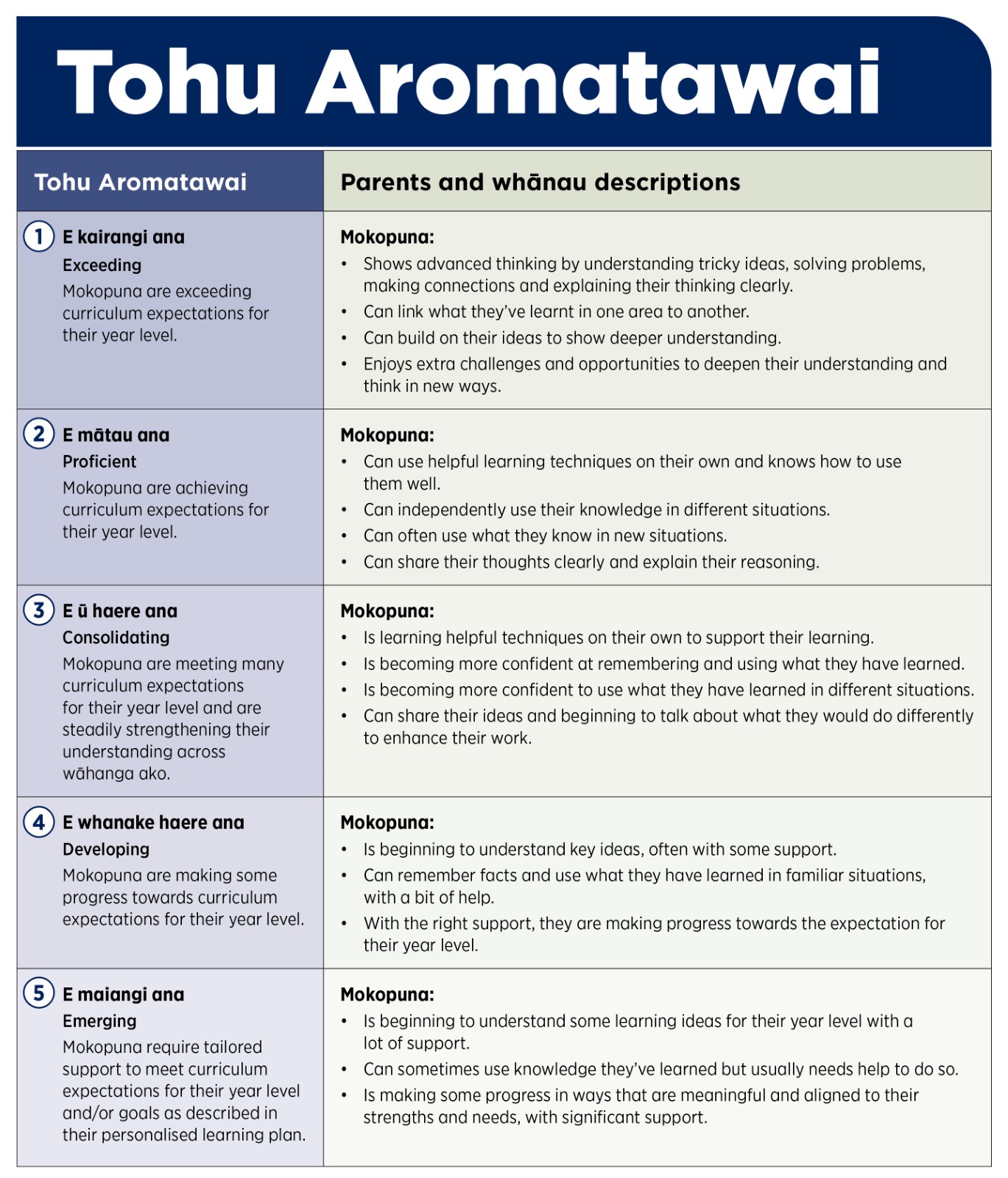
Tohu Aromatawai are intended to provide a consistent language to report on progress. They are clear, nuanced, strength based, and help identify where mokopuna are achieving, and what is needed to support further progress.
The goal for the end of the year is that mokopuna reach 'E mātau ana' or above, showing they are ready for the next year of learning.
The table below explains each of the 5 Tohu Aromatawai you may see on a report for your mokopuna.
Is my mokopuna on track#
This diagram helps show how mokopuna progress is tracked through the year.
Mid-year#
If at mid-year a kaiako considers mokopuna to be:
- e maianga ana or e whanake haere ana, this means mokopuna are still learning critical knowledge for their year level and needs some support. They are making progress, but they’re not yet on track to meet the end of year expectations.
- e ū haere ana, e mātau ana or e kairangi ana, this means mokopuna are on track for their year level. They are learning well and building confidence.
End of year#
If at the end of the year, the kaiako decides mokopuna are:
- e mātau ana or e kairangi ana, mokopuna have met or exceeded the expectations for their year level
- e maianga ana, e whanake haere ana, or e ū haere ana, mokopuna have made progress and is learning steadily, but they have not yet met all the expectations for their year level.
For mokopuna with diverse learning needs, or who have individualised progress goals and assessments outlined in their Individual Education Support Plans (IEP), reporting should reflect progress toward those personalised goals, alongside curriculum expectations.
How kaiako will select Tohu Aromatawai#
Kaiako use a wide range of information to understand how mokopuna are progressing and achieving. This includes what they notice in the akomanga, conversations with mokopuna, and examples of their learning throughout the year.
If you would like to see more detail about the information used, you can ask your mokopuna and their kaiako. Some kura may also include this information in reports, share it during parent and whānau‑kaiako meetings, or make it available through online school portal.
Throughout the year, kaiako collect information from classroom observations, conversations in tairongo, completed work, and assessment tools like SMART or Hihira Weteoro. Putting all this together helps them understand mokopuna progress, achievement and success.
No single piece of evidence gives the full picture. Kaiako bring together everything they know about mokopuna to decide which Tohu Aromatawai best reflects their progress at that time.
What you'll see in a mokopuna report#
At least twice a year, kura are required to provide a written report to mokopuna, and their parents and whānau, in plain language on mokopuna progress and achievement across the curriculum. From 1 January 2027, kura will have to include the following components. This will be in addition to other information the kura currently includes in its reports.
The elements are:
- results from twice-yearly aromatawai
- progress against strands in Te Reo Rangatira and Pāngarau
- progress and achievement in pānui and tuhituhi
- Tohu Aromatawai
- information about how the kura is supporting mokopuna if they are well below the curriculum expectations
- an attendance record (except for distance schools)
- mokopuna next learning steps.
These components are not designed to replace current reporting practices, but they need to be included in some way in all reports from the start of 2026 onwards.
Example#
Below is an example of how these elements may appear in a report for your mokopuna. Existing report structures can still be used by kura as long as these elements are included.
A visual showing progress over time#
A visual representation of progress over time allows you to understand the progress and achievement of mokopuna, not only within their current year of learning but also across multiple years throughout their schooling.
This example shows what a mid-year report might look like for a Year 4 mokopuna. It highlights progress only against the expectations for their current year, rather than comparing them with other years. This gives a clear picture of whether they are meeting, exceeding, or still progressing toward this year’s expectations.
Supporting mokopuna with complex learning needs#
From 2027, the components described above will appear in reports for all mokopuna in Aotearoa, including those with complex learning needs.
The Tohu Aromatawai chosen by the kaiako will show how your mokopuna is progressing toward curriculum expectations, and the written explanation will describe this progress in more detail, recognising individual needs or learning plans for your mokopuna.
If your mokopuna has complex learning needs and requires tailored support for their learning, this does not mean that they are not proficient in the curriculum. They should not be automatically assessed as ‘E maianga ana’, or ‘E whanake haere ana’.
For mokopuna with diverse learning needs, or who have individualised progress goals and assessments outlined in their Individual Education Support Plans (IEP), reporting should reflect progress toward those personalised goals, alongside curriculum expectations.


Audio#

Audio – Guide to reporting your mokopuna progress and achievement
Guide to reporting your mokopuna progress and achievementNew Zealand Sign Language (NZSL)#
A guide to reporting mokopuna progress and achievement – NZSL
A guide to reporting mokopuna progress and achievement – New Zealand Sign Language