On this page
- All children's workers must be checked
- The components of a safety check
- Identifying equivalent overseas convictions
- Safety checks by a third party or approved safety check service
- Licensing and certification criteria requirements
- Right to access records of safety checks
- Safety checking tools and resources
A key part of early learning service providers' health and safety responsibilities is to carry out appropriate safety checking, police vetting, and risk assessment processes for people who work in or have access to a service.
Different legislative requirements apply depending on whether an individual is:
- a children's worker under the Children's Act 2014 or
- another person connected with the service.
These are related processes. Both require a police vet, to help identify and manage risks to children but they serve different purposes.
If the person is a children's worker#
They need a full safety check which includes a police vet component to meet the requirements of the Children's Act 2014.
Children’s Act 2014 – New Zealand Legislation
If the person is not a children's worker#
You will need to determine if the person is someone covered by Education and Training Act 2020 Schedule 4 police vetting requirements.
Schedule 4 of the Education and Training Act 2020 – New Zealand Legislation
See the page below for guidance.
All children's workers must be checked#
Under the Children's Act 2014, all children's workers must be:
- safety checked before they begin work and
- rechecked every 3 years.
It is an offence to employ or engage a children's worker without completing the required safety check before they start work. It is also an offence to fail to complete a safety recheck every three years.
If another organisation has safety checked a person on your behalf, you are still responsible for making sure they have completed all the required safety check components.
Who is a children's worker?#
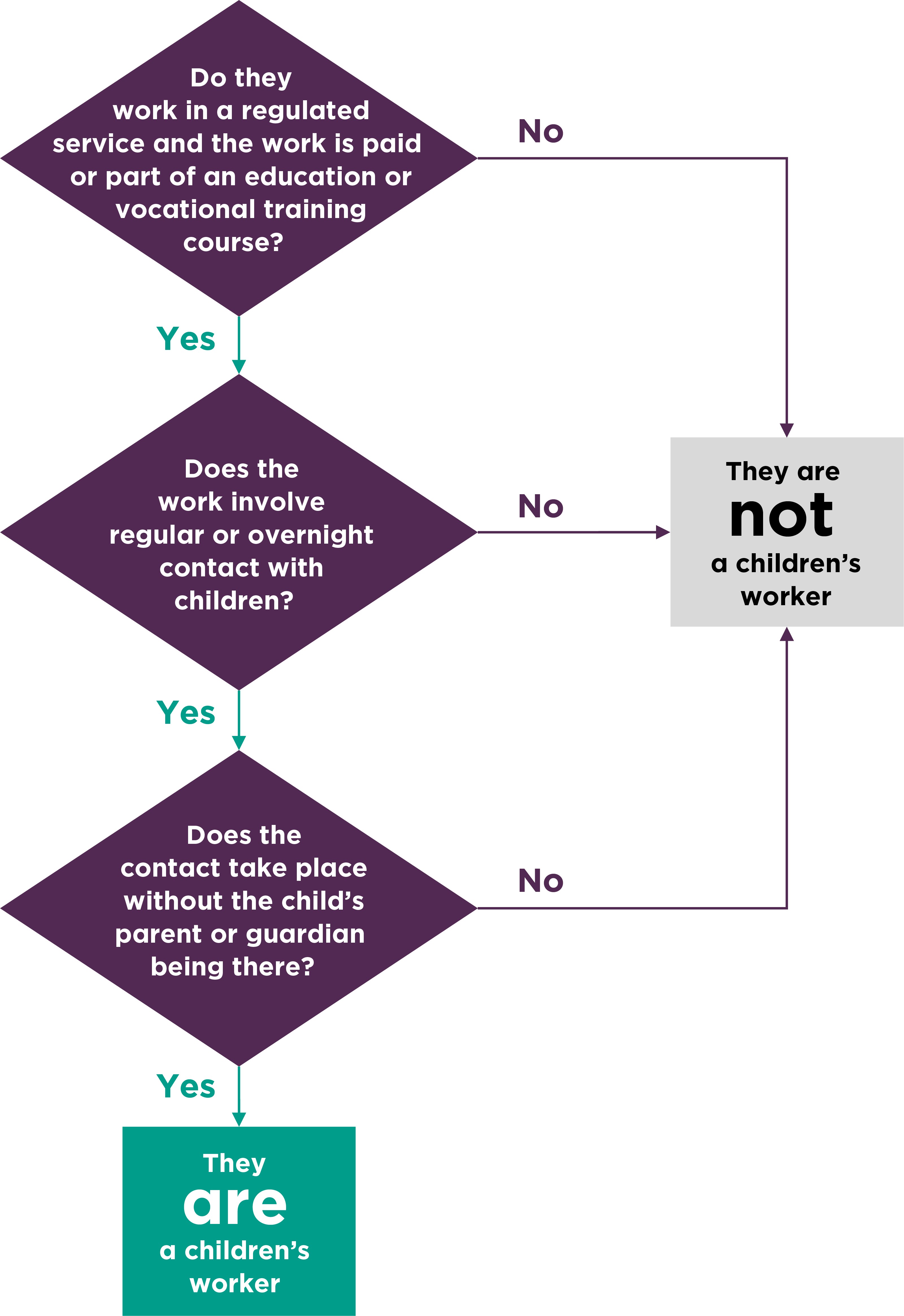
It’s important to correctly identify roles so that you can apply the right requirements. Click on the flowchart below to enlarge it.
As you will see, nearly everyone working in your early learning service is considered a children’s worker.
This includes:
- service providers, service owners, managers, head teachers and persons responsible
- teachers, including relief teachers (independent or from an agency)
- other staff who have regular contact with children
- coordinators and educators in home-based services
- students working in your service as part of their educational or vocational training, including school students
- staff employed by other organisations who work at your service such as early intervention teachers.
Core or non-core workers#
If you have identified your staff are children's workers, you will then need to work out if they are classified as core or non-core children's workers. See the factsheet below.

The components of a safety check#
A safety check is more than obtaining a police vet. It involves gathering and assessing information to determine whether a person poses any risk to the safety of children.
The components of a safety check must include:
- identity confirmation
- work history
- information from any relevant professional organisation or registration body
- any other information considered to be relevant including a check of personnel records
- applicant interviews
- reference checking
- information about previous criminal convictions (police vetting)
- risk assessment.
You can find more information on the roles and specific components of safety checking in the Children’s Act 2014 guide below.

Police vetting is one component of the safety check process for children's workers required by the Children's Act 2014.
On 24 October 2026, more offences were added to Schedule 2 of the Children’s Act. These convictions must be considered by organisations employing or engaging children’s core workers.
Children’s Act 2014: Schedule 2 – New Zealand Legislation
You must not engage or employ a person with a specified offence or an equivalent overseas conviction in a core children's worker role unless they have been granted a core worker exemption.
People can apply to Te Kāhui Kāhu for a core worker exemption.
Identifying equivalent overseas convictions#
The need to identify equivalent overseas convictions was introduced on 24 October 2026 as part of the Government’s response to the Abuse in Care Royal Commission of Inquiry.
From 24 October 2026, overseas convictions equivalent to Schedule 2 offences under the Children’s Act 2014 must be considered when safety checking core children’s workers.
You cannot employ or engage a person with an equivalent overseas conviction as a core children's worker, unless they have been granted a core worker exemption.
Transition period for existing children’s workers until 24 April 2027#
By 24 April 2027 you must not continue to employ or engage a core worker who has an overseas conviction equivalent to a Schedule 2 offence.
This means that from 24 April 2027 the following people cannot continue in a core worker role unless they are granted a core worker exemption:
- a core worker with a conviction listed in Schedule 2
- a core worker with an equivalent overseas conviction
- an existing core worker with a conviction for a newly added offence.
You can find detailed guidance on the page below. Identify and complete relevant steps in the guidance and record the process you follow.
Safety checks by a third party or approved safety check service#
To avoid conflicts of interest, owners and operators of early learning services must use an independent third party or an approved safety-checking service to complete:
- their own safety checks
- the safety checks of anyone who is related to them or with whom they have a close personal connection.
Using a third-party individual#
A third party is someone who provides services to you but is employed or engaged by another organisation. For example the principal of the local school or someone who is an independent contractor or person.
If you use an independent third party to safety check your children's workers you are responsible for confirming these are completed and that a person does not pose a risk to children.
Using an approved safety check service#
CV Check NZ has been approved to do safety checks on children's workers.
You can choose to use this service, or another service that meets the appropriate standards.
Children's worker safety check – CVCheck NZ
You will need to pay to use a screening service.
Using previous employers' safety checks#
You must not use a safety check completed by a children's worker's previous employer.
Licensing and certification criteria requirements#
Services must have a written procedure for safety checks, maintaining a record of the safety checks they have completed and the results.
You can find out more about the requirements for each service type below.
Right to access records of safety checks#
You must show us and ERO your procedures and any safety check records, if asked.
You must also show any safety check records to other agencies if requested. This is permitted under the Children's Act.
Children's Act 2014: Powers of entry and inspection – New Zealand Legislation
Children's Act 2014: Requirement to provide information – New Zealand Legislation
Safety checking tools and resources#
Tools to help complete safety checks at your early learning service.